
亚历克西斯·勒博尔涅:一段生命与梦想的故事
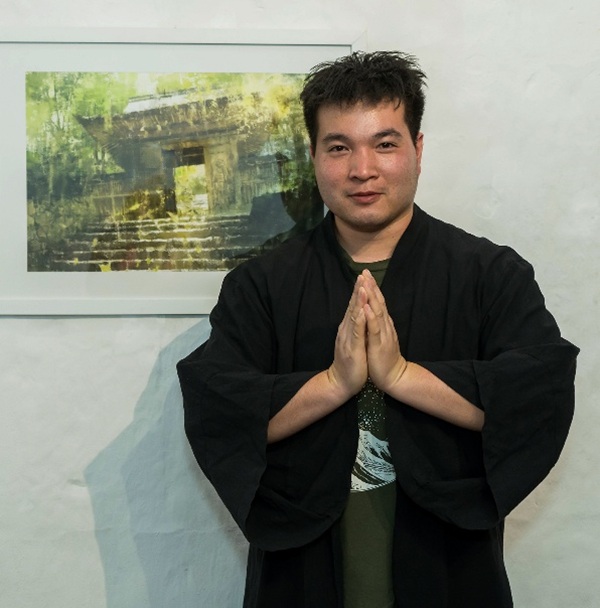
亚历克西斯・勒博尔涅
一、艺术家简介
亚历克西斯・勒博尔涅(Alexis Le Borgne),法国当代具象艺术家,主攻色粉与水彩。熟稔西方写实绘画技法,却不拘泥于物象复刻。他深度研习日本茶道、侘寂、幽玄等东方美学,持续突破创作边界,将对时光、生命与残缺之美的感悟注入作品,构建起融汇东西方审美的独特艺术语言,画面沉静克制,于朴素物象间传递丰沛的精神力量。
勒博尔涅的创作分为有形技艺与无形精神两大维度。其东方主题创作并未堆砌异域符号,而是汲取东方美学内核,借西方成熟绘画技法承载东方哲思,消解东西方审美壁垒,形成写实质感与精神意境兼备的艺术风格。
突破固有创作范式,深耕精神表达是他一贯的追求。他主动跳出创作舒适区,每年更换创作主题,在陌生探索中磨砺艺术感知。他认为题材无高下,日常片段、转瞬即逝的自然光景皆可入画。其创作有着清晰的转型轨迹:早期侧重技法打磨与视觉叙事,后期摆脱物象复刻,转向情绪与氛围的精神表达。而东方题材成为重要纽带,衔接起技艺与精神,成为他艺术突破的现实载体。创作时他注重沉浸式感知,赋予作品叙事感与情感温度。
二、艺术家自述
我生于 1995 年,自幼热爱艺术绘画。2010 年接触水彩,成为我艺术生涯的重要转折点,2011 年首次个展,正式开启艺术之路。之后我尝试粉彩、油画、丙烯等多种媒介,作品在各类艺术展会中获奖,更加坚定我以艺术为毕生事业。真挚的交流、探索、热忱与质朴,成为滋养我创作的力量。
2017 年起我全职投身艺术,不断拓展创作边界,涉足雕塑、插画、漫画、花艺与园林设计。各类媒介与技法拓宽了我的认知与艺术感知,个人与艺术同步成长,如同拼图慢慢成型,我始终渴望发掘全新主题与表达,不断突破自身能力。
探索与追问是艺术的根基。每年我都会主动踏入并不熟悉的创作领域,在学习磨合中深化认知,重塑自身感知。早期创作侧重美学与叙事,而后我希望强化作品中情感、共鸣与精神这些 “无形” 内核,亚洲题材恰好为我提供契机,平衡技法、叙事、视觉语言这些 “有形” 要素。
我始终认为没有糟糕的题材,只有糟糕的构图,日常所见皆可入画。受茶道思想启发,我崇尚不完美、易逝、时光流转之中的含蓄之美。花艺创作里,残破器皿与盛衰不一的花枝彼此呼应,我也把纸张痕迹、肌理瑕疵转化为绘画优势,在艺术与生活中学会接纳与释怀。我偏爱低沉内敛的 “有色灰”,称之为 “低语的颜色”。大众常觉得我偏爱绿色,实则我同等喜爱蓝、粉、紫,只是钟情自然本身,绿色是自然丰富乐章里的篇章。
我的创作灵感来自故事、瞬间与情绪,如同诗歌。我会依据时节、灵感确立年度核心主题,维系展览的整体性。无论何种题材,我都致力于捕捉生命转瞬即逝的感受,带领观者向内感受,每幅作品都承载独有的氛围,也投射出我的一部分。各个创作系列推动我跳出表层描摹,走向以感受为核心的表达。正如我常对学生所说,创作要真切感知风声水流、草木肌理,乃至对象内在的思绪与灵魂。
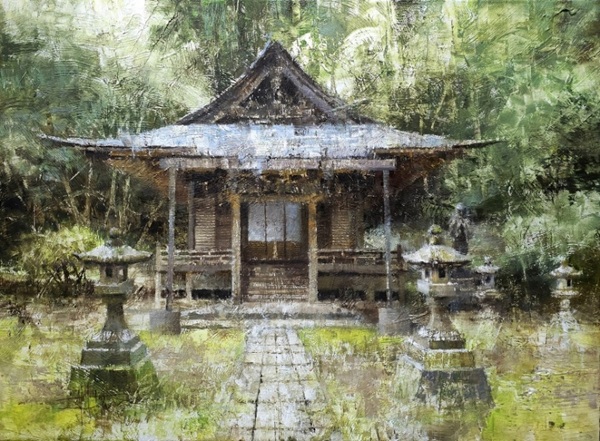
亚历克西斯・勒博尔涅作品
三、访谈
一、成长根源与美学缘起
1. 您成长于越南与法国布列塔尼两种截然不同的文化语境中,这段特殊的成长经历,是否让您更早体悟时光流变、物象无常与精神归属的命题?这种生命感知,是否促成了您对日本美学中瞬时、留白、质朴特质的天然认同与审美亲近?
我是被收养的,六个月大时来到法国。这些理念一直潜藏在我内心;在并未真正意识到的情况下,我感到对它们有一种自然的牵引。在内心深处,我一直与现代西方思维格格不入——那种强调控制、完美等等的思维方式。
日本一直影响着我的生活,通过园林艺术、哲学、音乐、建筑、诗歌,以及审美与文化的精致。然而,很长一段时间里,我无法完全把握其中的联系,这些元素感觉像是散落的拼图碎片,几乎有一种怀旧之感……肯定是前世的影响!直到最近,凭借这些年积累的反思与成熟,我才得以将自己的绘画、世界观与这些基本原则编织在一起。我人生拼图中散落的碎片终于归位,揭示出那些与我真实自我、审美视野和感受力共鸣的更深层概念。作为人类,我们自然地在进化,作为艺术家也是如此。
2. 您提及日本文化自童年起便对您产生深远影响,能否分享具体的经历与契机,让您初次与日本美学达成精神共鸣,并逐步确立为自身核心的创作审美取向?
从很小的时候起,我就被与日本相关的树木和植物所吸引:枫树、榅桲、山茶、马醉木、樱花、木兰……我会花时间观察苔藓,以及树木分枝结构的平衡,实体与虚空的互动,这是对最终不过是一个极其普通场景的一种不寻常视角。
我八岁时买了一本关于梵高的书,当时给我留下最深刻印象的作品正是那些受日本启发的。回想起来,我甚至用学校级别的水粉临摹过其中几幅!我小学附近还有一栋受日本启发的建筑,我回家路上常会花时间凝视它。我喜欢原始的质感,不对称的、粗糙的陶瓷;被时间风化的家具木材;低语般的色调……直到最近我才得知,日语中有一个专门的词来形容这个:Wabi-sabi(侘寂)。事实上,我喜爱的一切都有对应的特定表达:Yūgen(幽玄)、阴影之美与赞美;Komorebi(木漏れ日)、阳光轻抚树叶;Miyabi(雅)——精致……
二、核心创作哲学与艺术认知
3. 您提出“没有糟糕的题材,只有糟糕的构图”的创作理念,强调绘画的核心并非复刻客观物象,而是捕捉瞬时情绪与生命意蕴。在创作实践中,您如何从平凡的日常场景与细碎瞬间中提炼审美诗意,构建画面独有的氛围感与叙事性?
我经常向我的学生们解释这个原则:一幅技术有瑕疵但构图出色的画,永远比一幅构图糟糕但技术完美的画更有冲击力……这正如烹饪、音乐或文学一样。生活中所有这些平行事物构成一个有机的整体,我并不贬低精确再现对象的能力,超写实主义在这方面是完美的,因为我相信这是艺术多样性和个人享受的一部分。最重要的是艺术家为自己设定的目标。就我而言,我是一个讲故事的人,也是情感的传达者。我的秘诀在于这两个元素:一个简单的废弃罐子或一朵枯萎的花,可以通过艺术家的敏感性和视觉语言揭示其真正的美。具象的方面仅仅是冰山一角。我还能为这个主题带来什么?我想向观者传达什么?这个主题吸引我的是什么,我应该突出什么?我把每幅画构思成一首视觉诗,努力将我全部的灵魂与真诚倾注其中。
4. 您将创作划分为“有形”的技法、叙事、视觉语言与“无形”的情感、振动、精神两大维度,并完成了从视觉再现到精神表达的创作转型。请问您为何选择以亚洲、日本题材作为实现这一艺术进阶的核心载体?
这些是我感到最大和谐与共生的主题。当我作画时,我的指尖会感到刺痛,以及一种难以言喻的感觉。要完全进入冥想状态并触及最佳的振动,我需要一个能与我建立深层连接的主题。我喜欢画各种主题,但那些最能引起共鸣、揭示我内在自我的感觉像是一种灵魂的袒露。自从我2022年开始日本系列以来,绘画从未有过如此强大或精神上深刻的感觉。
5. 在您的艺术体系中,技法与叙事是创作基础,最终服务于精神内核的表达。在具体创作过程中,您如何界定作品的创作边界,判断画面已然脱离表层视觉再现,抵达纯粹的情感与精神表达维度?
一切始于一个想法、一个愿望或一个要讲述的故事。技术性的创作过程需要时间,从各种探索性的草图中演变而来。光影的互动、构图、明暗与色彩的和谐、季节,这些都是完善一幅画所需的技术元素。这个过程本身就像最终创作作品一样令人愉悦和兴奋,它类似于电影导演,介于概念艺术与插画之间;技术基础是必不可少的。
然而,情感与精神的维度则通过灵魂的语言来表达。这就是为什么未来永远属于传统艺术,而不是人工智能!没有灵魂与共鸣的图像只是完成工作的视觉伎俩,却无法触及那些无形的、更深层次的意义。因此,我让完成的草图静置并成熟。我等待完美的时机让一幅画诞生,作画时并非总能成功,只因为作品反映的是自我,它取决于当时的情绪、心境,以及身心健康。我只有在与画作建立起对话,并伴随着一种圆满感时,才认为一幅画完成了,这就是为什么所花费的时间与创作过程无关。
三、日本东方美学的内化与重构
6. 您以“在不完美、脆弱与时光流逝中探寻谦逊之美”为核心审美准则,且溯源日本茶道美学。这一独特的审美认知,是基于对茶道、花道、侘寂理论的系统研习,还是长期艺术实践与审美直觉沉淀而成的创作理念?
必须说两者兼而有之。这种感受力是随着时间推移,在我精炼自己的感知和对简约的追求中形成的,在平凡中揭示美,远离任何炫耀的矫饰。通过阅读,我发现日本茶道正是源自这种心态,由大师千利休所确立。我从中看到了惊人的相似之处,并发现自己与那种艺术形式产生共鸣。如今,我将绘画行为本身视为一种仪式,一种正念的状态,在我的心中,每一个动作都以慢动作展开,美就在于行为本身。在我握持粉彩或画笔的方式中,让它在与我的手和心灵和谐中发挥全部潜力。插花艺术(Ikebana)让我精炼了对“平衡的失衡”构图本质的理解。我也喜欢玩弄对立:明与暗、压力与轻盈、慢与快、力量与柔软、模糊与清晰……
7. 西方传统艺术崇尚精致、规整、圆满的审美范式,而您受侘寂、幽玄等东方美学影响重塑了自身创作思维。请您谈谈,这种审美变化,为您的艺术创作与表达带来了哪些关键性的转变?
确实,从童年起我们就被条件化,从学校开始,比如不要画出线外。这是我与绘画学生一起打破的障碍,我玩弄并利用人们通常试图避免的一切:纸上的瑕疵、污渍、滴落、过宽的笔触,或“浑浊”的颜色。对我来说,每一个不完美都是一种资产,例如,粗糙的“torchon”(冷压/粗糙)水彩纸纹理在法国常被回避。然而,正是这种粗糙、不可预测的表面,让我能够实现令人难以置信的纹理并保留纸的白色。我的色板更加精致,由细腻的灰色和极少刺眼的色调组成,保持一种低调的优雅。从更玄奥的角度来说,江本胜博士关于水记忆的工作也塑造了我对水彩的感知,以及过程中注入意图的重要性。
8. 您的作品主动接纳肌理瑕疵、画面斑驳、自然残缺等非完美视觉效果,常以开裂器物、失衡花枝、盛衰共生的物象构建画面。对您而言,接纳不完美是专属的画面技法语言,还是贯穿您艺术创作与个人生活的核心价值态度?
要在绘画中拥抱不完美,就必须在生活中拥抱它。正如我常说的,一幅画仅仅是其创作者的反映,这不是“风格”的问题,而实际上是一种心境和生活哲学,这是我许多学生难以把握的。我无法教他们画得“像勒·博尔涅那样”,因为连我自己也无法做到……然而,我可以帮助他们摆脱对完美控制的需求,将他们推向极限,让他们走出舒适区,以揭示隐藏的潜力。理解一个主题可能在草图阶段就已经完整,因为一切都已说完。这是一个需要时间真正内化的概念。
四、绘画技法、色彩与媒介表达
9. 您长期运用色粉、水彩、油彩等西方绘画媒介,精准诠释日式静谧、残缺、空灵的东方意境。在笔触运用、肌理塑造、色彩层次处理上,您是否形成了适配东方美学表达的专属技法体系与创作逻辑?
在我看来水彩是最接近传统西方方法的技法。它体现了几个世纪以来中国书法大师的遗产。人们常因握笔方式,直立并握住笔杆最末端,以确保动作最大流动性而将两者相提并论。笔触灵动而精准,需要在精确的时刻和位置使用适量的水和颜料。这正是有趣之处:它关乎在技术严谨与放手之间找到平衡,与水达成和谐的共鸣。因此,水彩仍根植于传统,它是一种祖先的艺术遗产。中国拥有一些最有才华的水彩画家并非巧合,如:关维兴、陈希旦等。
10. 绿色被大众视作您的标志性色彩,而您始终强调自身只是纯粹热爱自然。在自然题材创作中,您如何突破唯美风景的浅层视觉表达,通过色彩调度、感官营造与氛围构建,赋予画面深层的情绪意蕴与精神内核?
我在大自然中的过去经验,让我回到工作室后能调动感官。我专注于元素及其纹理,而不仅仅是视觉方面。我需要感受苔藓的柔软,听到流水或落雨的声音,感知干燥的树皮、灯笼的花岗岩、风,以及一束光线的温暖……每一个细节都让事物鲜活起来。这关乎理解并感受主题,以便诠释并掌握它。我不断地分析和沉思自然的各种形态,它滋养着我。然后我努力通过作品向它致敬,正如滨野贵志用他的水族造景所做的那样。
五、东西美学融合与作品价值认知
11. 西方艺术史上长期存在对东方文化的符号化、猎奇化表达,而您的作品实现了东西方美学的深度融合与共生。在您看来,东西方艺术审美的核心差异是什么?您如何平衡西方绘画的技法优势与东方美学的精神内核,实现二者的有机统一?
这是一个交叉点,又一个寻求平衡的实例。我相信“平衡”是我生命中最重要的词。近年来我主要观察到的是,在西方我们拥有情感能力却缺乏技术,而在东方,情况大体相反。因此,我尝试在这两个维度上努力,将这两种能力融合,而不以牺牲一方来成全另一方,始终追求平衡。在西方,重点往往在于表面的审美呈现,在思想和执行的深度与成熟度上常有欠缺;相反,在东方,后者的特质更为突出。当然,我并非一概而论;这是基于我作为参展者和评委的经验所做的分析,这也取决于具体的国家和其历史。
12. 市场与观众常以“禅意”“极简”“日本风”等标签定义您的作品,您如何看待这类固化的审美标签?同时,您在创作中如何厘清美学借鉴与文化挪用的边界,始终保持自身艺术创作的独立性与独特性?
我不太在意标签。想要把事物放入框中、比较并分类,是人类的本性。我因欲望和对自由的渴望而绘画,我很幸运不必屈从于规则或潮流,也不必在艺术和个人成长中面对约束或阻碍。自由一直是并将继续是我的目标:为了绘画而生活,而不是相反。对我来说,无论作为艺术家还是作为人,最本质的是保持真实,对自己和他人真诚。我不喜欢“挪用”这个词,因为它关乎自我,没有什么真正属于我们。我更偏爱“文化借用”的概念:通过自己的感受力翻译一种文化的本质,而不扭曲它。这是一种深深的尊重,我更愿意在一种不同于自己的文化面前鞠躬,通过作品向它致敬,并在此过程中更好地理解它,让它在我身上留下印记。
六、创作延续与未来探索
13. 您将亚洲题材作为探索情感与精神内核的重要载体,若未来创作题材发生转变,您长期沉淀的侘寂美学、瞬时美学等核心创作理念,将通过哪些全新题材与艺术形式延续表达?
艺术生涯首先是一段旅程,有时我会提前数年规划一个目的地,等待自己达到必要的成熟水平。然而,我也喜欢让自己被旅途的曲折和意外时刻所惊喜,发现隐藏的目的地并探索。日常生活场景、夜景、室内、风景、寺庙、肖像、花卉、构图、野生动物、民俗、佛教与神道教、现代与历史……主题和题材是无穷无尽的,一生似乎太短。对我来说,最重要的是避免常规和舒适区。我希望有一天能回望这段完整的旅程,为所走过的里程和达成的里程碑感到自豪。我的视觉语言及其执行的演变则是另一回事,有一点是确定的:基本支柱将保持不变,只有形式本身会随着岁月演变。
14. 对您而言,东方美学是一种创作方法论、一种审美态度,还是贯穿您艺术生涯与个人生活的整体价值范式?未来您是否会持续深耕东方美学题材,并在技法、意境与主题表达上开展新的艺术探索与突破?
这是这三要素的巧妙融合,就像三根支柱提供坚实的基础。我作为画家的使命是传达情感与梦想,讲述故事并传播一种宁静与善意,我将继续遵循我的原则与理念,始终寻求成长与持续学习,这就是旅程的丰富性,一段生命与梦想的故事。
Interview OutlineI.
Roots of Growth and Origins of Aesthetics
1. You grew up in two distinctly different cultural contexts—Vietnam and Brittany, France. Did this unique background allow you to grasp earlier the themes of the passage of time, the impermanence of things, and the question of spiritual belonging? Has this life perception fostered a natural affinity and aesthetic closeness to the Japanese qualities of transience, empty space (ma), and simplicity?
I was adopted and arrived in France at the age of six months. These ideals had always lain dormant within me; without truly realizing it, I felt a natural pull toward them. Deep down, I have always gone against the grain of modern Western mindsets—with their emphasis on control, perfection, and the like.
Japan has always influenced my life—through garden art, philosophy, music, architecture, poetry, and aesthetic and cultural refinement. Yet, for a long time, I couldn't quite grasp the connection; these elements felt like scattered puzzle pieces. There is almost a sense of nostalgia... surely the influence of a past life!
Only recently have I been able to weave together my painting, my worldview, and these fundamental principles, thanks to the reflection and maturity I have gained over the years. The scattered pieces of my life’s puzzle have finally fallen into place, revealing deeper concepts that resonate with my true self, my aesthetic vision, and my sensibilities. We evolve naturally as human beings, and consequently, as artists as well.
2. You have mentioned that Japanese culture has profoundly influenced you since childhood. Could you share specific experiences or turning points that first created a spiritual resonance with Japanese aesthetics and gradually established it as the core aesthetic orientation of your creative work?
From a very young age, I was drawn to trees and plants associated with Japan—maples, quince, camellias, andromedas, cherry blossoms, magnolias... I would spend my time observing mosses and the balance of a tree’s branching structure, the interplay of solid forms and empty space—an unusual perspective on what was, in the end, a perfectly ordinary scene.
I had bought a book about Van Gogh when I was eight years old, and the works that made the greatest impression on me at the time were those inspired by Japan. Come to think of it, I even copied several of them using school-grade gouache!
There was also a Japanese-inspired building near my primary school; I used to spend time gazing at it on my way home.
I love raw textures: asymmetrical, rough ceramics; the wood of a piece of furniture weathered by time; tones that whisper... It was only recently that I learned there was a Japanese term for this: *Wabi-sabi*.
In fact, there is a specific expression for everything I love: *Yūgen*—the beauty and praise of shadow; *Komorebi*—sunlight caressing the leaves; *Miyabi*—refinement...
II. Core Creative Philosophy and Artistic Understanding
3. You propose the idea that “there are no bad subjects, only bad compositions,” emphasizing that the essence of painting is not to replicate objective reality but to capture fleeting emotions and the essence of life. In your practice, how do you extract poetic beauty from ordinary daily scenes and fragmentary moments, and construct a unique atmosphere and narrative quality in the picture?
I often explain this principle to my students! A painting with technical flaws but an excellent composition will always have more impact than one with a poor composition but perfect technique... It is just like in cooking, music, or literature; all these parallels in life form a cohesive whole. I do not discount the ability to reproduce a subject exactly—hyperrealism is perfect in that regard—as I believe it is part of the diversity and personal enjoyment of art. What matters most is the goal the artist sets out to achieve. For my part, I am a storyteller and a conveyer of emotion. My secret lies in these two elements: a simple discarded canister or a withered flower can reveal its true beauty through an artist's sensitivity and visual language. The representational aspect is merely the tip of the iceberg. What more can I bring to the subject? What do I want to convey to the viewer? What appeals to me about the subject, and what should I highlight? I conceive each painting as a visual poem, striving to pour my entire soul and sincerity into it.
4. You divide creation into two dimensions: the “tangible” (technique, narrative, visual language) and the “intangible” (emotion, vibration, spirit), and you have completed a transformation from visual representation to spiritual expression. Why did you choose Asian and Japanese subjects as the central vehicle for achieving this artistic advancement?
These are the subjects with which I feel the greatest harmony and symbiosis. I feel a tingling in my fingertips and an indescribable sensation when I paint. To fully enter a meditative state and tap into the best possible vibration, I need a subject with which I can forge a deep connection. I enjoy painting all kinds of subjects, but the ones that resonate most—that reveal my inner self—feel like a form of baring my soul. Painting has not felt this powerful or spiritually profound since I began my Japan series in 2022.
5. In your artistic system, technique and narrative form the foundation of creation, ultimately serving the expression of the spiritual core. In the concrete process of making a work, how do you define the boundaries of creation and judge that the picture has moved beyond surface visual representation to arrive at a pure dimension of emotional and spiritual expression?
It all begins with an idea, a desire, or a story to tell. The technical creative process takes time, evolving from various exploratory sketches. The interplay of light, composition, the harmony of values and colors, the season—these are all technical elements that go into perfecting a painting. This process is just as enjoyable and exciting as the act of creating the final piece itself. It is akin to film directing, hovering somewhere between concept art and illustration; the technical foundation is essential.
The emotional and spiritual dimension, however, is expressed through the language of the soul. That is why the future will always lie in traditional art, not in artificial intelligence! Images devoid of soul and resonance are merely visual artifices that get the job done but fail to reach those invisible, deeper layers of meaning. Consequently, I let my sketches sit and mature once they are finished. I wait for the perfect moment to bring a painting to life. One cannot always succeed when painting, simply because the work reflects the self; it depends on one's mood, state of mind, and physical and mental health at any given moment. I consider a painting complete only when a dialogue is established between it and me, accompanied by a sense of fulfillment. That is why the time spent is irrelevant to the creative process.
III. Internalization and Reconstruction of Japanese and Eastern Aesthetics
6. You take as a core aesthetic principle “seeking a humble beauty in imperfection, fragility, and the passage of time,” tracing it back to the aesthetics of the Japanese tea ceremony. Was this distinctive aesthetic understanding formed through systematic study of tea ceremony, ikebana, and the theory of wabi-sabi, or did it gradually crystallize through long-term artistic practice and aesthetic intuition?
There is, I must say, a bit of both. This sensibility was forged over time as I refined my perception and my quest for simplicity—revealing beauty within the mundane, far removed from any ostentatious artifice. Through my reading, I discovered that the Japanese tea ceremony had originated from this very mindset, established by the master Sen no Rikyū.
I saw a striking parallel there, and found myself resonating with that art form. Today, I view the act of painting as a ceremony in its own right—a state of mindfulness where every movement unfolds in slow motion within my mind, and where beauty lies in the act itself: in the way I hold a pastel or a brush, allowing it to realize its full potential in harmony with my hand and my spirit.
”Ikebana has enabled me to refine my understanding of "balanced imbalance"—the very essence of composition. I also love playing with opposites: light and dark, pressure and lightness, slowness and speed, strength and softness, blur and clarity...
7. Traditional Western art has long favored refined, ordered, and complete aesthetic paradigms, while you have reshaped your creative thinking under the influence of wabi-sabi, yūgen, and other Eastern aesthetics. Could you talk about the fundamental and critical transformations this aesthetic renewal has brought to your artistic creation and expression?
It is true that, starting in childhood, we are conditioned—right from school—not to step outside the lines, for instance. That is a barrier I break down with my painting students. I play with and turn to my advantage all the things people usually try to avoid: a flaw in the paper, a stain, a drip, an overly broad brushstroke, or a "muddy" color.
For me, every imperfection is an asset. For example, the rough, "torchon" (cold-press/rough) watercolor paper texture is often shunned in France. Yet it is precisely this rough, unpredictable surface that allows me to achieve incredible textures and preserve the white of the paper. My color palette is more refined, composed of nuanced grays and very few garish tones, maintaining a sense of understated elegance. On a more esoteric note, Dr. Emoto’s work on the memory of water has also shaped my perception of watercolor and the importance of the intention infused into the process.
8. Your works actively embrace imperfect visual effects such as textural flaws, mottled surfaces, and natural incompleteness, often constructing the picture with cracked vessels, unbalanced branches, and objects that embody both flourishing and decline. For you, is the acceptance of imperfection a specific pictorial language, or is it a core value attitude that runs through both your artistic creation and your personal life?
To embrace imperfection in one’s painting, one must embrace it in life. As I often say, a painting is merely a reflection of its creator. It is not a matter of "style," but rather—in reality—a state of mind and a philosophy of life; this is something many of my students struggle to grasp. I cannot teach them to paint "à la Le Borgne," because even I am incapable of doing that... However, I can help free them from the need for perfect control, push them to their limits, and draw them out of their comfort zones to reveal their hidden potential. Understanding that a subject may be complete at the sketch stage—because everything has already been said—is a concept that takes time to truly internalize.
IV. Painting Technique, Color, and Medium Expression
9. You have long employed Western painting media such as pastel, watercolor, and oil to precisely interpret Japanese qualities of quietness, incompleteness, and ethereal emptiness. In the handling of brushwork, texture, and color layers, have you developed a distinctive technical system and creative logic adapted to the expression of Eastern aesthetics?
To my mind, watercolor is the technique that comes closest to traditional Western methods. It embodies the centuries-old legacy of the great masters of Chinese calligraphy. People often draw this parallel because of the way the brush is held—upright and by the very end of the handle—to ensure maximum fluidity of movement. The brushwork is spirited and precise, requiring the right amount of water and pigment at the exact right moment and place. This is where it gets interesting: it is about striking a balance between technical rigor and a sense of letting go—finding a harmonious accord with the water. Watercolor thus remains rooted in tradition; it is an ancestral artistic heritage. It is no coincidence that China is home to some of the most talented watercolorists—artists such as Guan Weixing, Liu Yi, Rick Yuang, and Xidan Chen, among others.
10. Green is often regarded by the public as your signature color, yet you consistently emphasize that you simply love nature. In works on natural subjects, how do you move beyond the shallow visual expression of beautiful scenery and, through the orchestration of color, the creation of sensory experience, and the construction of atmosphere, endow the picture with deeper emotional meaning and spiritual substance?
My past experiences in the great outdoors allow me to engage my senses once I am back in the studio. I focus on the elements and their textures, rather than just the visual aspect. I need to feel the softness of moss, hear the sound of trickling water or falling rain, and sense the dry bark, the granite of a lantern, the wind, and the warmth of a ray of light... Each of these details brings things to life. It is about understanding and sensing the subject in order to interpret and master it. I constantly analyze and contemplate nature in all its forms; it nourishes me. I then strive to pay tribute to it through my work, just as Takashi Hamano did with his aquascaping.
V. Fusion of Eastern and Western Aesthetics and Understanding of the Work’s Value
11. Western art history has long contained symbolic or exoticizing representations of Eastern culture, whereas your works achieve a deep fusion and coexistence of Eastern and Western aesthetics. In your view, what are the core differences between Eastern and Western artistic aesthetics? How do you balance the technical strengths of Western painting with the spiritual core of Eastern aesthetics to achieve an organic unity of the two?
It is a crossroads—yet another instance of seeking balance. I believe "balance" is the most important word in my life. What I have observed in recent years—predominantly—is that in the West, we possess emotional capacity but lack technique, whereas in the East, the situation is largely the reverse. I have therefore tried to work on both these dimensions to merge these capabilities, without sacrificing one for the sake of the other—always in pursuit of balance. In the West, the focus tends to be on surface-level aesthetic presentation, often lacking depth and maturity in terms of ideas and execution; conversely, in the East, those latter qualities are what stand out. Of course, I am not generalizing; this is an analysis based on my experiences as an exhibitor and a jury member. It also depends on the specific country and its history.
12. The market and audiences often define your works with fixed labels such as “Zen,” “minimalist,” or “Japanese style.” How do you regard such solidified aesthetic labels? At the same time, how do you clarify the boundary between aesthetic borrowing and cultural appropriation in your creation, so as to maintain the independence and uniqueness of your artistic practice?
I care little for labels. It is human nature to want to put things into boxes, to compare and classify. I paint out of desire and a thirst for freedom; I am fortunate not to have to bow to rules or trends, nor to face constraints or hindrances in my artistic and personal growth. Freedom has been—and remains—my goal: to live to paint, rather than the other way around. For me, both as an artist and as a human being, the essential thing is to remain authentic, to be true to myself and to others.
I dislike the term "appropriation," as it speaks to the ego. Nothing truly belongs to us... I far prefer the concept of "cultural borrowing": translating the essence of a culture through one's own sensibility without distorting it. It is a matter of deep respect; I prefer to bow before a culture different from my own, to pay tribute to it through my work—and in doing so, to understand it better and let it leave its mark on me.
VI. Continuity of Creation and Future Exploration
13. You regard Asian subjects as an important vehicle for exploring emotion and the spiritual core. If your creative subjects change in the future, through what new subjects and artistic forms will the core creative ideas you have long cultivated—such as wabi-sabi aesthetics and the aesthetics of the momentary—continue to be expressed?
An artistic career is, above all, a journey. Sometimes I plan a destination years in advance, waiting until I have reached the necessary level of maturity. Yet, I also love letting myself be surprised by the twists and turns of the journey and the unexpected moments that arise—discovering hidden destinations and exploring. Scenes of daily life, nightscapes, interiors, landscapes, temples, portraits, florals, staged compositions, wildlife, folklore, Buddhism and Shintoism, the modern and the historic... The subjects and themes are inexhaustible; a lifetime seems all too short. For me, the most important thing is to avoid routine and the comfort zone. I hope that one day I can look back on this entire journey and feel proud of the miles covered and the milestones reached.
The evolution of my visual language and its execution is another story entirely. One thing is certain: the fundamental pillars will remain; only the form itself will evolve over the years.
14. For you, is Eastern aesthetics a creative methodology, an aesthetic attitude, or an overall value paradigm that runs through your artistic career and personal life? Will you continue to deepen your engagement with Eastern aesthetic subjects in the future, and undertake new artistic explorations and breakthroughs in technique, artistic conception, and thematic expression?
It is a skillful blend of these three elements—akin to three pillars that provide a solid foundation. My mission as a painter is to convey emotions and dreams, tell stories, and spread a sense of serenity and kindness. I will continue to follow my principles and ideas. Always seeking growth and perpetual learning—that is the richness of the journey, the story of a life and a dream,